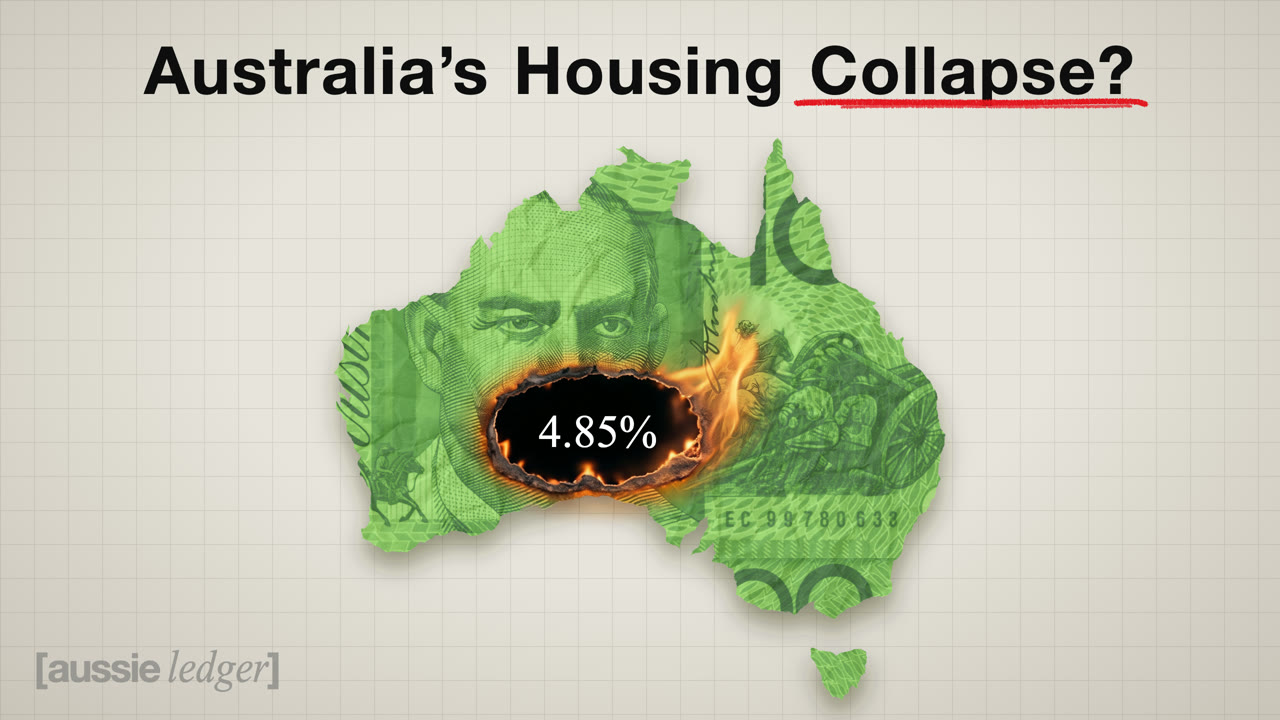
Australia’s Housing Market Is Breaking — And the RBA Just Made It Worse
Each claim in the video is listed below in the order it is made, with the source it comes from. Figures marked “our calculation” were worked out from the data linked. Quotes were checked against the page they come from. Where the video rounds or words something differently from the source, we say so. To report an error, leave a comment on the video.
Cotality calls its October index “Cotality Home Value Index”; Cotality was previously called CoreLogic, which is the name used at one point in the video. Forecasts are forecasts: CBA moved its call from 9% to 14% in two months, and they can move again.
Method
House prices are Cotality’s Home Value Index for October 2026, as reported by The New Daily and CommBank. Each city’s fall is measured from its own peak. Interest-rate facts come from the RBA’s 3 November 2026 decision as reported by ABC News, Domain and SBS. Inflation figures are the ABS monthly CPI for September 2026. Repayment figures are Canstar’s modelling for a $600,000 owner-occupier loan with 25 years left. Where we say “our calculation”, we worked the figure out from those numbers.
Labels
Claims and sources
- 01
SOURCED
House prices are falling at the fastest pace in 40 years.
Cotality: the combined capitals fell 8.1% in seven months, “the fastest fall Cotality has recorded in at least 40 years”. CommBank: “The pace of decline is the fastest in at least 40 years.”
- 02
SOURCED
The median Australian home is now worth $884,855.
The New Daily: Cotality’s October index “shows another 1.2 per cent drop in the national median to $884,855.”
- 03
OUR CALCULATION
In March it was worth about $948,000 — $63,400 gone in seven months.
The New Daily: values fell 6.7% since the March peak, “wiping about $63,400 from national values”. $884,855 + $63,400 = $948,255.
- 04
SOURCED
Seven months in a row, every month down.
CommBank: national values fell 1.2% in October, “their seventh consecutive monthly decline”.
- 05
SOURCED
On 3 November the RBA lifted the cash rate to 4.85% — the fifth hike this year and the highest since late 2008.
ABC News: “The decision lifts the cash rate target to 4.85 per cent, up from 4.60 per cent. It is the highest cash rate since late 2008. It is the fifth interest rate increase in 2026.”
- 06
OUR CALCULATION
A 10% deposit on the $948,000 home is about $95,000; the market has eaten two thirds of it on paper.
10% of $948,255 = $94,826. The $63,400 fall is 67% of that deposit.
- 07
SOURCED
Sydney is down 10.1% from its February peak, Perth 8.9%, Brisbane 8.3%; Melbourne 8.2% from a peak in 2022.
Cotality data to 31 October 2026: Sydney −10.1% (peak February 2026), Perth −8.9% (April 2026), Brisbane −8.3% (May 2026), Melbourne −8.2% (March 2022).
- 08
SOURCED
Sydney is still $1.18 million and dropped 1.6% in October; Brisbane just over a million, down 2%; Perth $942,000.
The New Daily: Sydney fell 1.6% to $1,178,959; Brisbane fell 2% to $1,018,401; Perth fell 1.7% to $942,018.
- 09
SOURCED
Only two capitals went up last month: Hobart and Darwin.
The New Daily: the slump “affected all capital cities except Hobart (up 0.5 per cent to $743,854) and Darwin (up 0.6 per cent to $641,873).”
- 10
SOURCED
The median Sydney home is worth less than five years ago; Brisbane is still up 46% on five years ago.
The New Daily: Sydney “has dropped below where it was five years ago”; Brisbane “was still 46 per cent more expensive than five years earlier.”
- 11
QUOTE
Cotality’s head of research: the mid-sized capitals piled up so much value that they have a lot to give up.
Gerard Burg: “We saw such an enormous accumulation of value in those mid-sized capitals over the past five years… they have a lot they can give up.” The video paraphrases this.
- 12
SOURCED
A few months ago Perth was growing at around 25% a year; people called Brisbane bulletproof.
The New Daily: Perth “had an annual growth rate of about 25 per cent a few months ago”; “Previously bulletproof Brisbane”.
- 13
QUOTE
CommBank’s economist used the word “overexuberance”.
CommBank: “the speed of the reversal suggests overexuberance became a more important driver of price growth”.
- 14
QUOTE
A Melbourne agent of 28 years: some properties have gone back to 2017–2018 prices, which is “scary”.
Ray White agent Dexter Prack: “Some properties, they’ve gone back to 2017, 2018 prices, which is scary.”
- 15
SOURCED
The worst downturn in this data was 2017 to 2019: the five capitals fell 8.6%. This one is already at 8.2% in seven months.
CommBank: the five-capital index “is already 8.2% below its March peak… close to the 8.6% peak-to-trough fall recorded during the 2017 to 2019 downturn.”
The 2017–2019 downturn ran from October 2017 to May 2019, about 19 months (Cotality). CommBank’s five-capital index puts it at 8.6%; Cotality’s combined-capitals index puts the same downturn at 8.2% and today’s fall at 8.1%.
- 16
FORECAST
CommBank thinks this one goes to 15%.
CommBank: the five-capital city average is expected to fall “around 15%” peak to trough (national: around 14%).
- 17
SOURCED
The RBA has raised rates five times this year: February, March, May, September and November.
February (3.85%), March (4.10%), May (4.35%), September (4.60%, “fourth increase of 2026”) and November (4.85%, fifth).
- 18
SOURCED
In 2025 the RBA cut rates three times, down to 3.6%; in 2026 it added 1.25 points.
Three cuts in 2025 took the cash rate to 3.60%. Domain (Finder): “since January the cash rate will have climbed 1.25 percentage points”.
- 19
SOURCED
The decision was made on Melbourne Cup Day.
Domain: “the Reserve Bank of Australia (RBA) has lifted interest rates on Melbourne Cup day, to 4.85 per cent.”
- 20
SOURCED
Six board members voted to hike, three wanted to hold.
ABC News: “Six members voted to increase the cash rate target by 25 basis points to 4.85 per cent, while three members voted to leave the cash rate target unchanged at 4.60 per cent.”
- 21
QUOTE
Bullock on how high rates need to go: “I don’t know how high that is.” And: “Will we need more? I don’t know.”
Michele Bullock: “We will need to raise interest rates to the extent that we need to get inflation down. I don’t know how high that is.” … “Will we need more? I don’t know.”
- 22
QUOTE
“Five hikes this year, and that’s still got another 12 months to play through.”
Bullock: “We’ve done five hikes this year, and that has still got another 12 months to play through.”
- 23
SOURCED
Rate changes take 12 to 18 months to work through; some of this year’s decisions won’t be fully felt until 2028.
ABC News: “It takes between 12 and 18 months for a change in interest rates to flow completely through the economy, so we will not know what total impact this rate hike will have on economic activity until 2028.”
- 24
SOURCED
Prices rose 4.3% in the year to September, up from 4% the month before. The RBA’s target is 2 to 3%.
ABS / ABC: annual inflation 4.3%, “up from 4 per cent a month earlier”. The RBA’s target is 2–3%, aiming for the midpoint.
- 25
SOURCED
Housing costs were up 5.2%, fuel jumped 9.4%, underlying inflation is 3.6%.
ABC: housing rose 5.2%; “fuel prices… rose 9.4 per cent in September”; “The annual trimmed mean… picked up to 3.6 per cent”.
- 26
SOURCED
Markets priced about an 85% chance of a November hike; one economist called it the last data point the RBA needed.
ABC: “about 85 per cent, according to Bloomberg data”. KPMG’s Brendan Rynne: “the last data point necessary for the RBA to increase the cash rate for a fifth time this year”.
- 27
SOURCED
Oil supply disruption in the Middle East pushed fuel and inflation up.
RBA board, via ABC: “Global oil supply disruptions are maintaining upward pressure on global and domestic energy prices and inflation.”
- 28
QUOTE
Bullock: monetary policy can’t fix global oil prices, and those pressures were bigger than the bank expected.
Bullock: “Monetary policy cannot impact global oil prices.” … “We now think that those pressures were greater and contributed more to inflation than we judged before.”
She also said the RBA is “not tightening monetary policy because of the direct impact of oil prices on inflation” but because of pressures inside Australia.
- 29
QUOTE
Jim Chalmers: “We do have an inflation challenge in our economy. It is made much worse by the war in the Middle East.”
Chalmers: “We do have an inflation challenge in our economy, it is made much worse by the war in the Middle East”.
- 30
QUOTE
Deputy governor Andrew Hauser: more businesses think 3 to 3.5% inflation might be the new normal — “the central banker’s nightmare”.
Hauser: “There is an increasing share of businesses who are thinking that maybe 3 to 3.5 per cent is the new normal… That is the central banker’s nightmare.”
- 31
FORECAST
The RBA doesn’t expect inflation below 3% until late 2027 — about three quarters later than it thought.
ABC: inflation “was not expected to fall below 3 per cent until late 2027, which is ‘around three quarters later than previously forecast’.”
- 32
FORECAST
Unemployment is forecast to rise from 4.7% today to 5.1% by the end of 2028.
SBS: unemployment is 4.7%, the highest in five years. ABC: the RBA now forecasts it “to average 5.1 per cent” in the December quarter of 2028 (4.8% in August).
- 33
QUOTE
Bullock: not a recession, but it will “make people feel like it’s a recession because they feel poorer”.
Bullock: “We are not looking to tip the economy into recession if we can avoid it.” … “I think that is going to … make people feel like it’s a recession because they feel poorer”.
- 34
SOURCED
On a $600,000 mortgage, the minimum repayment is up about $456 a month since February.
Canstar’s modelling: five 0.25-point hikes since February add $456 a month for an owner-occupier with a $600,000 loan and 25 years left, assuming banks pass each hike on.
- 35
OUR CALCULATION
That’s roughly $5,500 a year.
$456 × 12 = $5,472.
- 36
SOURCED
Many people won’t see the November hike in their repayments until early 2027, because banks have to give notice.
Broker News: “Borrowers typically get two to three months’ notice before their repayments rise.” Two to three months after 3 November is January–February 2027.
- 37
SOURCED
Four hikes cut a typical household’s borrowing power by about $71,000.
The New Daily: “Four interest rate rises have eroded a median household’s borrowing capacity by about $71,000 since February, Burg said.” (Cotality, formerly CoreLogic.)
- 38
SOURCED
One in 10 mortgage holders say they won’t be able to cover the higher repayments.
Canstar survey of 1,012 adults in November: “10% of mortgage holders say they won’t be able to cover the higher repayments.”
- 39
SOURCED
Westpac’s consumer sentiment index fell to 78.2, a four-year low; the article was titled “Festive drear”.
Westpac: the index fell “2.7 per cent to 78.2 – its lowest level in four years”.
- 40
SOURCED
Mortgage holders: 68.1, the lowest since Westpac began measuring in 1994; 72% expect rates to rise within a year.
Westpac: confidence among mortgage holders “fell 11.6 per cent in November to 68.1, the lowest level recorded for this group since Westpac’s measures began in 1994”; “72 per cent expect mortgage rates to rise further over the next 12 months.”
- 41
SOURCED
Australians owe more than $2.5 trillion — more than three times what we owed 18 years ago.
Domain: “Australians in 2026 are carrying over $2.5 trillion in debt – more than three times what was owed 18 years ago.”
- 42
SOURCED
In 1989 home loan rates hit around 17%; the next year Paul Keating called it the recession we had to have.
The RBA’s indicator lending rates show the standard variable housing rate at 17% in 1989. Keating, November 1990: “this is the recession that Australia had to have.”
The video shortens Keating’s words to “the recession we had to have”, the form in which the phrase is usually remembered.
- 43
SOURCED
Higher rates mean better savings accounts — money moves from people who owe it to people who have it.
ABC: savers “will see their savings accruing more interest after today’s decision, if their bank applies higher rates”. ABC also ran an analysis titled “The brutal redistribution at the heart of the RBA’s interest rate policy”.
- 44
SOURCED
Fewer than half of homes at auction are selling; sales over three months are down 23% on a year ago; homes take longer to sell.
CommBank: “Sales over the past three months were 23% lower than a year earlier, auction clearance rates across the combined capitals were below 50% and homes were taking longer to sell.”
- 45
QUOTE
Bullock: “When turnover falls, people don’t go out and buy new things for their new houses.”
Domain: “When turnover falls, people don’t go out and buy new things for their new houses,” including furniture, appliances and renovations.
- 46
QUOTE
Bullock: the risk is that the housing decline “continues and continues much more severely”.
Bullock: “That is one possibility, that the housing price decline continues and continues much more severely.”
- 47
FORECAST
CommBank now expects national prices to fall around 14% peak to bottom; in September it said 9%.
CommBank: national prices “expected to fall around 14% from peak to trough”; in September “CBA projected a national peak-to-trough fall of around 9%”.
- 48
FORECAST
Brisbane and Perth down 18%, Sydney 16%, Melbourne and Adelaide 13%.
CommBank: Brisbane and Perth around 18%; Sydney around 16%; Melbourne around 13%; Adelaide around 13%.
In the video’s audio “Brisbane” can sound like another word; the forecast is for Brisbane and Perth.
- 49
FORECAST
ANZ says 13.5%, AMP says 15%.
MacroBusiness: ANZ tips “a 13.5% peak-to-trough decline across the capital cities”; AMP’s Shane Oliver “expects a 15% decline across the combined capital cities”.
- 50
OUR CALCULATION
So far we’re at about 8% — if they’re right, about halfway down.
Five-capital fall so far 8.2% (CommBank) against forecasts of 13.5–15%: 8.2 ÷ 15 = 55%.
- 51
OUR CALCULATION
If CBA is right, the average home bottoms out around $815,000 — roughly another $70,000.
$948,255 × (1 − 0.14) = $815,499; $884,855 − $815,499 = $69,356.
- 52
FORECAST
CBA’s path: down 8% this year, another 3% next year, stabilising in the second half of 2027, with no real recovery.
CommBank: prices to fall 8% over 2026 and 3% in 2027; “stabilise during the second half of next year”; “CBA does not expect a material recovery at that point”.
- 53
SOURCED
Stabilising needs lower prices, higher rents and eventually rate cuts; most economists don’t see a cut until late 2027.
CommBank: supported by “lower dwelling prices, higher rental yields… and an eventual easing in monetary policy”. The New Daily: “most economists not forecasting a cut until late 2027”.
- 54
FORECAST
New investors gain as rental yields climb toward 4.75%.
MacroBusiness, citing CBA: the 14% decline “is expected to lift the national gross rental yield to around 4.75%”.
- 55
SOURCED
The Aussie dollar fell 3% in a single week to about 68 US cents.
SmallCaps weekly wrap, week ending 13 November 2026: the Australian dollar fell 3.02% over the week to US$0.6796.
- 56
SCHEDULE
Dates to watch: RBA minutes (17 Nov), wages (18 Nov), inflation (25 Nov), house prices (1 Dec), the December RBA meeting.
FNArena: “Next week on the calendar are the November RBA meeting minutes and the 3Q26 Wage Price Index.” Westpac (via investingLive) refers to the RBA’s “December 7-8 meeting”.
The ABS lists the October monthly CPI for 25 November 2026. Cotality publishes its Home Value Index on the first business day of each month, which for November’s figures is Tuesday 1 December.
- 57
FORECAST
Westpac and EY think rates are now high enough and the RBA will pause.
Westpac “expects the central bank to pause at its December 7-8 meeting” and “does not expect a hike in February either”. EY’s Cherelle Murphy: “it is likely that policy is sufficiently restrictive”.
- 58
QUOTE
Betashares’ David Bassanese thinks they’ll hike again in February and called December’s likely pause a “Christmas reprieve”.
Bassanese: “My base case is the RBA will raise rates again in February 2027.” And to ABC News: the RBA will likely hold next month, “offering under-pressure households at least a Christmas reprieve”.
- 59
QUOTE
Bullock: “a massive supply shock… and we’re all poorer.”
Bullock: “we’ve had this massive supply shock imposed upon us and we’re all poorer”.
- 60
SOURCED
Canstar warned after this hike that savers are leaving money on the table.
Canstar’s Sally Tindall, 12 November 2026: “If you’ve got money in the bank, higher interest rates should be good news, but don’t assume you’re automatically getting the benefit.” After the previous hike, banks lifted base savings rates by a “measly 0.01 percentage point”.
“Leaving money on the table” is our summary of Canstar’s warning, not its exact words.